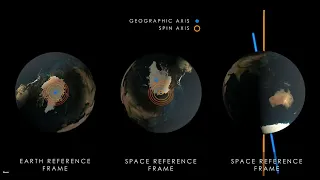
Earth axis rotation explained!
Earth axis rotation
1. The Mechanics: How Fast Are We Spinning?
Earth rotates on an imaginary axis that runs from the North Pole to the South Pole. While we don’t feel the movement, the speed is significant and varies depending on your location:
- At the Equator: You are moving at approximately 1,674 km/h (1,040 mph).
- At the Poles: Your rotational speed is essentially zero, as you are simply turning in place.
- Direction: Earth rotates West to East (counter-clockwise if viewed from above the North Pole), which is why the Sun, Moon, and stars appear to rise in the East and set in the West.
2. Solar vs. Sidereal Days
While we define a day as exactly 24 hours, there are actually two ways to measure a single rotation:
- Solar Day (24 hours): The time it takes for the Sun to return to the same spot in the sky.
- Sidereal Day (23 hours, 56 minutes, 4 seconds): The time it takes for Earth to rotate once relative to distant stars.
Note: The 4-minute difference exists because Earth is also orbiting the Sun; it has to rotate a little bit extra each day to bring the Sun back into the same overhead position.
3. The Consequences of the Spin
The Earth’s rotation isn't just a background event—it dictates the physical conditions of our planet:
- The Day-Night Cycle: This is the most obvious effect, creating the "diurnal" rhythm that governs life on Earth.
- The Coriolis Effect: Because the Earth is wider at the equator, different latitudes spin at different speeds. This causes moving air and water to "curve" rather than move in a straight line. This effect is responsible for the rotation of hurricanes and major ocean currents.
+2 - The Equatorial Bulge: Earth isn't a perfect sphere. The centrifugal force from its rotation causes the planet to "bulge" at the center, making it an oblate spheroid. You actually weigh about 0.5% less at the equator than at the poles because of this!
4. Why Does It Keep Spinning?
Earth continues to spin due to inertia. When the solar system formed from a collapsing cloud of gas and dust 4.6 billion years ago, it began to spin. Because there is very little friction in the vacuum of space to slow it down, Earth has kept that original "angular momentum" for billions of years.
