
As a GRI Certified Professional leading sustainability and AI consulting at Ark Nova here in Christchurch, I am constantly asked by engineering firms and policymakers: Will AI save our environment, or is it just accelerating our consumption?
Back to Articles
Using AI for Sustainability: A Guide for NZ Consultants
July 29, 2026
5 min read
Daniel Panjaitan
To find the answer, we must look beyond the hype and ask what real AI for sustainability actually requires. Henrik Skaug Sætra's 2022 book, AI for the Sustainable Development Goals, provides one of the most sobering and robust frameworks I have encountered.
The book doesn't act as a cheerleader for Big Tech. Instead, it systematically breaks down how artificial intelligence can both enable and inhibit the UN's 17 SDGs.
In this post, I'll break down the book's core concepts. Then I'll apply them directly to the New Zealand context — giving you a realistic, systemic approach to AI in your sustainability practice.
What is the dual nature of AI in achieving the Sustainable Development Goals (SDGs)?
AI has a dual nature: it can be both a powerful enabler and a critical inhibitor of the SDGs. AI can optimise resources and drive innovation. But deployed without considering the broader socio-technical system, it simultaneously risks increasing inequality and environmental degradation.
It is easy to be dazzled by the sunshine stories of AI success. That success can blind us to the fact that AI might simultaneously be an inhibitor. In my consulting work across New Zealand's engineering sectors, I constantly see this dual nature. A new AI tool might make a smart grid more efficient, helping SDG 7. But it's often controlled by proprietary overseas Big Tech companies — which can extract wealth and worsen local inequality. AI is not an isolated, neutral tool. We must evaluate it as part of a larger system — one that includes institutions, structures, and economic systems.
How Does AI for Sustainability Impact Economic, Social, and Environmental Outcomes?
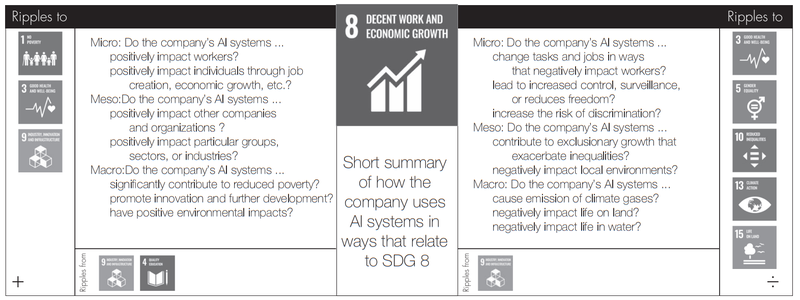
AI impacts sustainability on three levels: Micro, Meso, and Macro.
Furthermore, AI creates "ripple effects," where direct impacts on one goal, like innovation (SDG 9), indirectly affect poverty, education, and climate action. Sætra's framework is brilliant because it refuses to just "count" positive AI use cases. Instead, it breaks impacts down across three levels:
- Micro-level impacts: How AI affects individuals and small groups. For example, a personalised AI health app might improve an individual's wellbeing (SDG 3).
- Meso-level impacts: How AI affects larger organisations, classes, and nations, particularly regarding differential impacts and inequality.
- Macro-level impacts: Long-term effects on political and economic systems, such as AI's role in creating "surveillance capitalism" or changing taxation and regulation structures
In the Canterbury agricultural sector, for instance, we see AgriTech using AI for autonomous tractors and precision irrigation. This boosts yields, directly helping SDG 2 (Zero Hunger). But the technology is expensive and proprietary. That cost can hurt small-scale farmers — a negative impact on SDG 10 (Reduced Inequalities) .
Why are SDG 8 (Decent Work) and SDG 9 (Innovation) considered foundational "keystone" goals for AI?
SDGs 8 and 9 are top-level goals because AI's direct impacts on economic growth, infrastructure, and innovation dictate success across all other SDGs.
However, if AI-driven growth remains proprietary and exclusive, it threatens to exacerbate inequalities rather than solve them. Sætra identifies SDG 8 (Decent Work) and SDG 9 (Innovation and Infrastructure) as the most critical goals. They produce major ripple effects on almost every other SDG. However, the book issues a stark warning. Current AI development is heavily concentrated in a few US and Chinese "Big Tech" corporations. If innovation relies on proprietary algorithms and closed datasets, it prevents the local capacity-building that SDG 9 explicitly requires
What are the hidden environmental costs of Artificial Intelligence in climate action (SDG 13)?
While AI optimises energy grids and climate modelling, training large AI models generates massive greenhouse gas emissions.
Treating AI purely as a green solution ignores its significant energy footprint and the risk of promoting unsustainable resource extraction. When consulting for local government on emissions reductions, I always highlight a crucial distinction from the book: the sustainability of AI, versus AI for sustainability. Training large natural language models requires immense computing power. That, in turn, generates significant greenhouse gas emissions -- a well-documented fact. Furthermore, AI's ability to optimise systems is morally neutral. The same AI technology can map vulnerable New Zealand coastlines for conservation (SDG 14). But oil and gas companies can just as easily use it to optimise fossil fuel extraction.
How can New Zealand sustainability consultants use this framework to avoid "techno-optimism" traps?
Consultants must adopt a systemic approach. In practice, that means:
- Evaluating AI's long-term socio-political impacts
- Challenging the assumption that technological growth alone solves environmental issues
- Applying frameworks like human rights to protect individual liberties
Sætra points out a fascinating limitation of the SDGs themselves. They're built on a foundation of techno-optimism and a belief in continuous economic growth. This represents a "shallow form of environmentalism." It focuses on tweaking symptoms through tech fixes, rather than addressing the root causes of our unsustainable systems. As practitioners, we cannot rely on isolated proofs-of-concept to justify AI investments. We must ask the hard questions: Who owns the data? Who benefits from the efficiency? Are we just optimising a fundamentally unsustainable process? By combining the SDG framework with a deeper evaluation of individual rights and data ownership, Ark Nova helps organisations deploy AI responsibly. The result: real progress toward a better, fairer future.

Daniel Panjaitan
GRI Professional
Ark Nova Founder & GRI Professional